In This Article
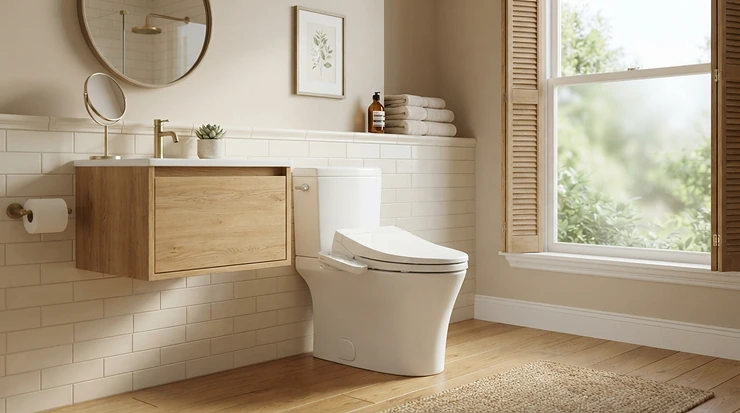
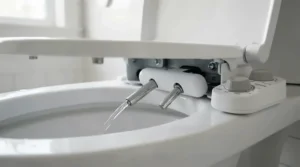
A dual nozzle bidet attachment for postpartum care is a slim, non-electric spray unit that sits under your existing toilet seat and connects to the cold water line. One nozzle rinses the rear. A second, gentler nozzle handles front-side perineal cleansing, so you can skip wiping while stitches, swelling, and soreness settle down.
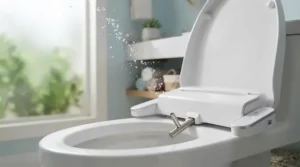
Let’s be honest about week one. Dragging dry toilet paper across a swollen, bruised, possibly stitched perineum is like sanding a sunburn. The hospital sends you home with a squeeze bottle, and it works. But it also asks a lot of a person who can barely sit down: bend, aim, squeeze, refill, repeat, with a newborn who has opinions about your timing.
That’s the gap a bidet attachment fills. Bidets themselves are hardly a fad. They’re plumbing fixtures with a long history across Europe, Asia, and parts of Latin America, and the clip-on version simply brings the idea to a standard American toilet for roughly the cost of a nice dinner out. Press a dial, get a steady stream of water, and keep your hands free. No contortions.
This guide covers seven real, widely sold models. It’s built on spec analysis, retailer rating signals, and what independent roundups report. I haven’t personally tested any of these products, and I won’t pretend otherwise. What you’ll get is honest reasoning about what each spec means for a healing body, plus practical setup advice. It isn’t medical advice, so your midwife or OB has the final word on your recovery.
Quick Comparison: 7 Dual Nozzle Bidet Attachments at a Glance
| Product | Standout Feature | Price Range | Best For |
|---|---|---|---|
| LUXE Bidet NEO 185 Plus | Slide-in install, lift-hinge cleaning | $50-$65 | Easiest everyday upkeep |
| LUXE Bidet NEO 185 | Huge review base, metal-ceramic valves | $45-$60 | Buyers who want proven track record |
| SAMODRA Ultra-Slim | 0.19-inch profile, tiny price | $20-$35 | Tight budgets, narrow seats |
| BIGCOW Ultra-Slim | Retractable self-cleaning dual nozzles | Budget tier (check current price) | Frontal-wash focus on a budget |
| Hodvit Dual Nozzle | Listed filtration feature | $28-$40 | Extra nozzle protection |
| Atzeste Ultra-Slim | Stainless steel inlet | $25-$40 | Durability-minded budget buyers |
| Liba Dual Nozzle | Built around elongated bowls | $60-$75 | Elongated-toilet households |
Looking at the table, the LUXE Bidet NEO 185 and LUXE Bidet NEO 185 Plus sit at the top of the price band, and what you’re paying for is install convenience and a long track record, not extra water features. The SAMODRA Ultra-Slim and Atzeste Ultra-Slim prove that the core job (two nozzles, adjustable pressure, no electricity) costs very little. The Liba Dual Nozzle is the outlier: priciest here, with the thinnest review evidence I could verify.
💬 Just one click — help others make better buying decisions too!😊
Top 7 Dual Nozzle Bidet Attachments for Postpartum Care: Expert Analysis
Every model below is a cold-water, non-electric attachment with a rear nozzle and a separate feminine nozzle. That shared DNA matters. The differences come down to fit, build, cleaning convenience, and how much real-world evidence backs each one. Prices are ranges only, since they move constantly.
1. LUXE Bidet NEO 185 Plus — slide-in install, no seat removal
The standout here is the patented slide-in U-shaped installation, which lets you mount the unit without lifting off your toilet seat. When you’re running on four hours of broken sleep, skipping a wrench-and-bolts session is a real feature.
Beyond that, you get dual nozzles for rear and feminine wash, a 360° self-clean function, and EZ-Lift hinges that tilt the unit up for wiping underneath. On paper, those hinges solve the grimy-gap problem that plagues most clip-on bidets, which means less scrubbing in a bathroom you’re barely hobbling through.
Based on the spec sheet, this is the most “set it and forget it” option for a household where cleaning bandwidth is zero. One roundup I reviewed ranked it best overall for couples, which makes sense if multiple people share the toilet. The review pool I found is smaller than the one behind the standard LUXE Bidet NEO 185, so the evidence base is thinner, even though the design logic is sound.
Pros:
- ✅ Slide-in install without removing the seat
- ✅ EZ-Lift hinges make cleaning underneath easy
- ✅ Dual nozzles with 360° self-clean
Cons:
- ❌ Costs more than slim budget alternatives
- ❌ Smaller verifiable review pool than the NEO 185
Price check: expect roughly the $50-$65 range at the time of research. Good value if cleaning convenience is your priority.
2. LUXE Bidet NEO 185 — the proven dual-nozzle workhorse
This is the model that has accumulated the biggest review base in the dual-nozzle category: one roundup cited tens of thousands of reviews at a rating around 4.6 stars. A track record that long tells you something spec sheets can’t. Thousands of bathrooms have already stress-tested it.
The metal-ceramic core valves are the quiet hero. Controlling water flow with a ceramic valve, rather than a plastic one, generally means smoother, more gradual pressure changes. That’s exactly what you want when you’re easing from “barely a trickle” to “okay, that’s actually fine.”
The independent roundup that ranked it called the feminine wash “genuinely useful” during menstrual cycles and for postpartum care, which fits my read of the design. The separate nozzle is angled for front-side rinsing, so you aren’t improvising with the rear jet.
The broader review pattern across listings is easy installation and satisfying pressure control, with occasional fit questions on unusual toilet shapes. It’s the safe pick, and safe is underrated when you’re healing.
Pros:
- ✅ Very large, mostly positive review base
- ✅ Metal-ceramic valves for smooth pressure changes
- ✅ Separate rear and feminine nozzles
Cons:
- ❌ Pricier than ultra-slim budget models
- ❌ Cold water only, like most attachments
Price check: roughly the $45-$60 range. Strong value for a long-term household fixture.
3. SAMODRA Ultra-Slim — best budget pick at just 0.19 inches thick
Under a fifth of an inch. That’s how much height this attachment adds to your seat setup, which matters if you’ve ever had a clip-on bidet make your toilet seat wobble or sit crooked.
You get dual nozzles for posterior and feminine wash, adjustable water pressure, a self-cleaning nozzle, and non-electric operation. One roundup noted button switching between modes, which means you don’t have to twist a dial with a shaky, sleepy hand.
My take: this is the “prove it works before you spend more” model. The evidence behind it is substantial, with a roundup citing more than twenty thousand reviews at around 4.5 stars, and retailer listings of related SAMODRA models show ratings around 4.4. Independent reviewers repeatedly praise straightforward installation and customizable pressure. A recurring caveat in editorial roundups is compatibility, with one noting it doesn’t work with one-piece toilets.
Check your toilet type before ordering, and this one’s hard to beat on price.
Pros:
- ✅ Ultra-thin 0.19-inch profile
- ✅ Very large review base at a budget price
- ✅ Adjustable pressure with simple mode switching
Cons:
- ❌ Not compatible with one-piece toilets
- ❌ Cold water only
Price check: around the $20-$35 range. Outstanding value if your toilet is compatible.
4. BIGCOW Ultra-Slim — retractable dual nozzles with pressure control
Retractable is the key word. The nozzles tuck away when not in use and, per the listing description in one roundup, self-clean for a fresh start before and after each wash. For a postpartum bathroom that sees a dozen visits a day, that’s reassuring.
Pressure controls let you dial in the stream, and the unit is non-electric, so no outlet needed. An independent buying guide specifically pointed to this model alongside the NEO 185 for anyone needing frontal wash for feminine hygiene or postpartum care.
Here’s the honest caveat: I couldn’t verify a large pool of customer reviews for this model in the sources I checked, so I can’t tell you how it performs over a year of daily use. The features line up with what you need, and the editorial endorsement is real, but treat the long-term durability as unproven. Read the current listing’s reviews before buying.
Pros:
- ✅ Retractable self-cleaning dual nozzles
- ✅ Pressure controls for gentle adjustment
- ✅ Named by a roundup for postpartum frontal wash
Cons:
- ❌ Fewer verifiable reviews than the big sellers
- ❌ Cold water only
Price check: it sits in the budget tier at the time of research; check the current price. Solid value, pending your own review of recent feedback.
5. Hodvit Dual Nozzle — the one with a filtration angle
Most attachments simply pass water through. The Hodvit version advertises filtration, which, for nozzles that sit inches from sensitive skin, is an interesting selling point.
I’d read the filtration claim conservatively. In this product class, an inlet filter usually protects the nozzle from sediment and mineral grit rather than purifying water to any medical standard, unless the manufacturer states otherwise. That’s still useful. Gritty water hitting a healing perineum is the last thing you want, and clogged nozzles are a common bidet complaint.
The rest of the package is standard: self-cleaning, adjustable pressure control, cold-water dual nozzle spray, and universal sizing. Retailer ratings I found landed in the high-4-star range, though the review count varies by listing version. If you live in an area with hard water or older pipes, the extra protection is worth considering.
Pros:
- ✅ Filtration feature for nozzle protection
- ✅ Self-cleaning with adjustable pressure control
- ✅ High ratings on retailer listings
Cons:
- ❌ Filtration claims lack clear detail
- ❌ Cold water only
Price check: around the $28-$40 range. Good value, especially for hard-water households.
6. Atzeste Ultra-Slim — stainless steel inlet for longer-lasting connections
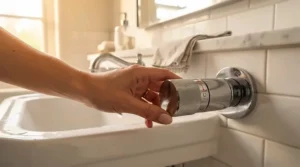
Here’s a detail most buyers overlook: the inlet is where bidet attachments tend to leak or fatigue, because it’s the point where plastic meets your plumbing. A stainless steel inlet is a straightforward durability upgrade over cheaper plastic connectors.
This model combines that with an ultra-slim profile, non-electric dual nozzles for rear and feminine wash, adjustable pressure, and a self-cleaning sprayer. Retailer listings I found showed ratings around 4.4 stars from a few hundred ratings, a decent but not huge sample.
My read: this is the budget buyer’s compromise. You get a slim, two-nozzle unit with one upgraded component that addresses the most common failure point. The smaller review pool means less certainty than with the LUXE Bidet NEO 185, but the price gap is meaningful.
Pros:
- ✅ Stainless steel inlet resists wear
- ✅ Ultra-slim dual nozzle design
- ✅ Adjustable pressure with self-cleaning sprayer
Cons:
- ❌ Smaller review pool than market leaders
- ❌ Cold water only
Price check: around the $25-$40 range. Strong value for durability-minded budget shoppers.
7. Liba Dual Nozzle — designed around elongated toilet bowls
If your toilet is elongated rather than round, fit can be the make-or-break issue, and this model is marketed specifically for elongated seats. That’s a tangible benefit for households where narrower attachments tend to shift or look awkward.
It offers self-cleaning dual nozzles for feminine and posterior wash, and it’s non-electric like the others. The tradeoff is evidence and price. Retailer listings showed about 4.3 stars from roughly 150 ratings, thinner than the field, while the price sits at the top of this group.
Here’s how I’d reason through it: choose this one only if fit on your specific elongated toilet is your main worry and the others’ compatibility notes concern you. Otherwise, the LUXE Bidet NEO 185 offers a bigger track record for similar money.
Pros:
- ✅ Built for elongated toilet seats
- ✅ Self-cleaning dual nozzles
- ✅ Feminine and posterior wash modes
Cons:
- ❌ Highest price in this lineup
- ❌ Lower rating from fewer reviewers
Price check: around the $60-$75 range. Fair value only if fit is your deciding factor.
Specs and Rating Signals Side by Side
| Product | Install Note | Rating Signal (at time of research) | Price Range | Best For |
|---|---|---|---|---|
| LUXE Bidet NEO 185 Plus | Slide-in, no seat removal | Smaller review pool | $50-$65 | Easy cleaning |
| LUXE Bidet NEO 185 | Standard clip-on | About 4.6 stars, very large pool | $45-$60 | Proven reliability |
| SAMODRA Ultra-Slim | 0.19-inch profile | About 4.5 stars, large pool | $20-$35 | Budget buyers |
| BIGCOW Ultra-Slim | Ultra-slim | Reviews not verified | Budget tier | Frontal-wash focus |
| Hodvit Dual Nozzle | Universal size | High-4-star range | $28-$40 | Hard-water homes |
| Atzeste Ultra-Slim | Stainless steel inlet | About 4.4 stars | $25-$40 | Durability on a budget |
| Liba Dual Nozzle | Elongated bowls | About 4.3 stars, small pool | $60-$75 | Elongated toilets |
The pattern is clear. Review volume and price don’t track each other, which means the cheapest ratings are often the best-evidenced. If you want the lowest risk, the LUXE Bidet NEO 185 and SAMODRA Ultra-Slim have the deepest evidence behind them at two very different price points. If you want the lowest-effort cleaning, the LUXE Bidet NEO 185 Plus is the standout. Ratings shift constantly, so verify current numbers before buying.
How to Choose a Dual Nozzle Bidet Attachment for Postpartum Care
Choosing well is mostly about avoiding two mistakes: buying something that doesn’t fit your toilet, and buying something with too little pressure control for a tender body. Work through these steps in order.
- Confirm your toilet type. Round versus elongated bowls, one-piece toilets, and odd seat shapes all affect fit. A compatibility miss is the most common reason to return one of these, so measure and read the listing’s fit notes first.
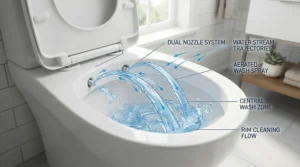
- Insist on two genuinely separate nozzles. The front nozzle should be a distinct, gentler outlet. A single nozzle you angle forward isn’t the same thing, because you’d be using the rear jet for a delicate area.
- Prioritize fine pressure control. Postpartum tissue is tender, and healing can take a while. Soreness can last up to six weeks after delivery, with stitches adding to the discomfort. You want to start at a trickle and creep up, not guess.
- Look for a self-clean function. You’ll be cycling between the rear and front nozzles. A built-in rinse cycle addresses the obvious hygiene concern.
- Check thickness and seat stability. Ultra-slim models add less height, so your seat sits flatter, which matters when you’re perching carefully.
- Weigh install effort against your energy. Slide-in designs and tool-free setups save you a frustrating hour you don’t have.
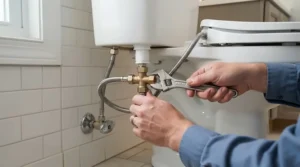
- Plan for cold water. Most non-electric attachments use the cold supply. Some hot-and-cold dual-inlet versions exist, but they need extra plumbing.
Use this as a filter, then compare against the table above.
Your First 30 Days: A Practical Setup and Usage Guide
This is where an attachment earns its keep. A few practices, none of which appear on an Amazon listing, make the difference between “nice gadget” and “genuinely helpful recovery tool.”
Before baby arrives (or before you’re home): Install it early. A bathroom project is far easier at 36 weeks than at four days postpartum. Test the water pressure at the lowest setting and learn which dial does what.
Week one routine:
- Start at the lowest pressure setting, every time. Your tolerance changes day to day.
- Use the front nozzle for perineal cleansing, directed so water flows front to back, never the reverse.
- Blot dry with a soft towel or tissue. Don’t rub.
- Run the self-clean cycle after each use.
Weeks two to six: Increase pressure only as comfort allows. Many people find they no longer need the full rinse after a bowel movement but still like the front wash after urinating, since urine stings tender skin.
Maintenance schedule: Once a week, wipe the nozzle housing and the area under the unit with a mild soap solution. A self-cleaning nozzle rinses the nozzle with water, which isn’t the same as disinfecting it. Check connections monthly for slow leaks, particularly on models with plastic inlets.
Common first-month mistakes: cranking pressure because “it’s supposed to feel strong,” forgetting to clean under the unit, and using the rear nozzle on the front area. Slow down, keep it gentle, and your bathroom becomes a recovery station instead of a chore.
Real-World Scenarios: Which Pick Fits Which Postpartum Situation
Specs only matter when they meet a real bathroom. Here are three realistic profiles and how I’d match them.
Scenario 1: The first-time mom with a second-degree tear, tight budget. She’s recovering at home, wants to stop dreading the bathroom, and has little to spend. The SAMODRA Ultra-Slim fits: a low price, adjustable pressure, and a huge review base. She should confirm her toilet isn’t a one-piece model and plan on starting at the lowest setting.
Scenario 2: The household with three adults and a toddler. The bathroom gets heavy traffic, cleaning time is scarce, and nobody wants to unbolt a seat for deep cleans. The LUXE Bidet NEO 185 Plus earns its extra cost through slide-in install and lift-hinge cleaning. The LUXE Bidet NEO 185 is the alternative if the budget is tighter and you’re fine with a more traditional setup.
Scenario 3: The renter with an elongated toilet and hard water. She can’t modify anything and worries about mineral buildup. The Hodvit Dual Nozzle‘s filtration feature offers some nozzle protection, while the Liba Dual Nozzle addresses elongated fit. I’d start with the Hodvit and verify its fit notes against her toilet.
✨ Don’t Miss These Exclusive Deals!
🔍 Take your postpartum recovery to the next level with these carefully selected products. Click on any highlighted item to check current pricing and availability. These tools can help you create a calmer, more comfortable bathroom routine your whole family will appreciate!
Problem → Solution Guide: Common Postpartum Bidet Headaches
Even good attachments create small headaches. Here are the four I’d expect, with fixes.
Problem: The water feels too cold. Non-electric attachments draw from the cold line, and cold water can feel jarring. Solution: use the lowest pressure first, let the line run briefly before engaging the nozzle, and consider a hot-and-cold dual-inlet model if cold really bothers you. Some people find cool water soothing on swollen tissue, so test before assuming it’s a drawback.
Problem: The stream feels too strong. Solution: back the dial off to its minimum and approach from a lower angle. If even the minimum is aggressive, a model with a finer ceramic valve, like the LUXE Bidet NEO 185, gives you a smoother ramp.
Problem: The seat wobbles or won’t sit flat. Solution: choose an ultra-slim model like the SAMODRA Ultra-Slim or Atzeste Ultra-Slim, and tighten mounting hardware evenly.
Problem: Water leaks at the connection. Solution: shut off the supply, check that the washer is seated, and consider a metal inlet like the Atzeste Ultra-Slim‘s if plastic fittings keep slipping. Never overtighten plastic threads.
Features That Actually Matter (And Those That Don’t)
Marketing copy loves buzzwords. Here’s what deserves your attention and what to ignore.
Gentle Feminine Wash Bidet Attachment: What “Gentle” Really Means
“Gentle” is a marketing word, not a spec. What makes a gentle feminine wash bidet attachment gentle is a combination of a dedicated front nozzle with a softer spray pattern and fine pressure control. If the same dial governs both nozzles with no granularity, “gentle” is just a label. Look for low-end control rather than adjectives.
Bidet Attachment With Separate Rear and Front Nozzle: Why Separation Matters
A bidet attachment with separate rear and front nozzle keeps the two zones physically distinct. That’s about hygiene, since you don’t want the nozzle that cleaned the rear aimed at the front, and it’s about comfort, since each nozzle is shaped for its job. A single multi-position nozzle is a compromise.
Adjustable Spray Pressure: The Feature to Test First
Adjustable spray pressure is the single most important feature for a healing body. Evaluate it by the low end of the dial. A unit that jumps from “off” to “firm” is a poor fit for week one, while one that offers a gradual ramp is ideal.
Self-Cleaning Nozzle: Useful, With Limits
A self-cleaning nozzle rinses the nozzle with water before and after use, which reduces buildup and gives you peace of mind between cleanings. It isn’t a disinfectant, so keep up the weekly wipe-down.
What you can skip: novelty finishes, extra attachments you won’t use, and marketing about “premium plastics.” Prioritize fit, pressure, and cleaning convenience.
Bidet Attachment vs Peri Bottle vs Handheld Sprayer vs Electric Seat
Each tool solves the same problem differently. The right one depends on your body, your bathroom, and your budget.
| Option | Water Source | Bending Required | Warm Water | Cost Range | Best For |
|---|---|---|---|---|---|
| Peri bottle | Filled by hand | Yes, to aim and squeeze | Yes, you control it | Around $10-$30 | Hospital stay, travel |
| Dual nozzle bidet attachment | Cold supply line | No | Usually no | Around $20-$75 | Daily home use |
| Handheld bidet sprayer | Plumbed hose | Some reaching | Depends on setup | Low to mid | Flexible aiming |
| Electric bidet seat | Outlet plus water line | No | Yes | Roughly $250-$500 | Maximum comfort |
A peri bottle is the cheapest option and gives you warm water on demand, but you’ll fill it again and again. An attachment removes the refill-and-bend cycle. An electronic bidet seat adds warm water and temperature controls, but it requires an outlet and costs many times more.
The attachment sits in the practical middle. It trades warm water for hands-free convenience at a fraction of an electric seat’s price. Many people keep a peri bottle as a backup, for the bedroom or a second bathroom.
Safety, Perineal Cleansing, and When to Call Your Provider
Gentle perineal cleansing supports healing, but a bidet attachment is a comfort tool, not a treatment. Know where it ends.
Perineal tears are graded by depth. Clinical classification runs from first-degree, affecting only skin and vaginal lining, up to fourth-degree, which involves the anal sphincter. The deeper the injury, the more individualized your care should be. If you had a third- or fourth-degree tear, confirm with your provider before using any pressure-based cleaning.
General principles worth following:
- Rinse front to back, always.
- Use the lowest pressure that cleans effectively, especially near stitches.
- Pat dry instead of rubbing.
- Change pads regularly. One source recommends about every four hours.
- Stitches typically dissolve within roughly 10-14 days, but healing continues beyond that.
Call your provider if pain worsens rather than improves, if you notice fever, a foul odor, or unusual discharge, or if the area looks increasingly red or swollen. Those can signal infection or wound complications, and no bidet attachment should delay that call.
Common Mistakes When Buying a Postpartum Bidet Attachment
A few predictable errors cost people money and comfort.
Skipping the fit check. The most common regret is a unit that doesn’t fit their toilet. Verify bowl shape and one-piece compatibility.
Buying on price alone. A very cheap unit with no pressure granularity can be worse than no bidet at all when you’re tender. Pay attention to the low end of the dial.
Ignoring cold water. Most attachments are cold-water only. If that bothers you, plan for it or look at dual-inlet versions.
Assuming self-clean means sanitized. Rinsing isn’t disinfecting. Keep a weekly cleaning habit.
Waiting until after delivery to install. Setting up beforehand saves effort when you can least afford it.
Using it as a substitute for medical care. It’s a comfort tool, not a healing guarantee.
Long-Term Cost and Maintenance: Is It Worth It?
Total cost of ownership here is refreshingly low. An attachment in the $20-$65 range is a one-time purchase, compared to roughly $250-$500 for an electric seat. There’s no electricity bill, and replacement parts, when needed, tend to be minor connectors.
On the value side, consider three payoffs. First, you cut down on how much toilet paper you use, though I won’t pretend to know your household’s exact savings. Second, the attachment keeps working long after postpartum recovery ends, for menstrual cycles, general hygiene, and every other adult in the house. Third, it spares you the repeated bottle-filling ritual during the hardest weeks.
Maintenance is light: a weekly wipe, a monthly connection check, and occasional nozzle cleaning in hard-water areas. Sturdier components, like the LUXE Bidet NEO 185‘s ceramic valves or the Atzeste Ultra-Slim‘s stainless steel inlet, can extend service life. Think of the attachment as a small, long-lived investment in a more comfortable bathroom, not a postpartum gadget you’ll abandon at week twelve.
FAQ
❓ Can I use a bidet attachment if I have stitches after delivery?
❓ Is cold water from a bidet attachment okay for postpartum use?
❓ Will a dual nozzle bidet attachment replace my peri bottle?
❓ Do these attachments fit every toilet?
❓ How long should I keep using one after birth?
Conclusion
The best dual nozzle bidet attachment for postpartum care is the one that fits your toilet, gives you a gentle low-end pressure, and keeps cleaning simple. For most households, the LUXE Bidet NEO 185 is the safest overall choice thanks to its deep review base and smooth valves. If cleaning ease is your priority, the LUXE Bidet NEO 185 Plus adds slide-in install and lift hinges. On a tight budget, the SAMODRA Ultra-Slim and Atzeste Ultra-Slim deliver the essentials for much less, while the BIGCOW Ultra-Slim, Hodvit Dual Nozzle, and Liba Dual Nozzle cover specific needs like frontal-wash focus, filtration, and elongated bowls.
Remember the basics: start at the lowest pressure, rinse front to back, pat dry, and call your provider if healing isn’t heading in the right direction. A bidet attachment won’t speed up your body’s timeline, but it can make each bathroom trip a little less dreaded, and in those early weeks, small wins matter.
Recommended for You
- Slim Profile Bidet Attachment for Small Toilets: 7 Best Picks 2026
- Hot and Cold Water Bidet Attachment for Sensitive Skin: 7 Best (2026)
- Non-Electric Bidet Attachment for Apartment Renters: 7 Top Picks 2026
Disclaimer: This article contains affiliate links. As an Amazon Associate, I earn from qualifying purchases. If you purchase products through these links, we may earn a small commission at no additional cost to you.
✨ Found this helpful? Share it with your friends! 💬🤗
