
In This Article
A slim profile bidet attachment for small toilets is a non-electric, under-the-seat water sprayer, usually a plate only a fraction of an inch thick, that taps your toilet’s existing water supply. It adds a rear wash (and often a feminine wash) without replacing your seat, noticeably lifting it, or claiming a single extra inch of floor space.
Small bathrooms are unforgiving. In a powder room where your knees nearly kiss the vanity, every millimeter is real estate. A bulky bidet doesn’t just look clumsy. It can tilt your seat, leave a gap that collects dust, and put stress on the plastic hinges. That’s why the thin, minimalist category exists, and why picking the wrong one is annoyingly easy.
Here’s the good news. The upgrade is cheap, it’s tool-light, and the upside is bigger than most people expect. A dermatology editorial indexed on PubMed Central makes the medical, environmental, and cultural case for bidets, and notes that a bidet uses roughly an eighth of a gallon per use. The catch, and this guide’s whole reason for existing, is fit.
Below you’ll find seven real, widely sold models compared on thickness, nozzle design, and real-world fit. You’ll also get honest analysis of seat gap clearance, narrow seats, and which products suit which bathrooms. Product details come from manufacturer listings and published roundups, and review sentiment is clearly labeled as aggregated.
Quick Comparison: 7 Slim Bidet Attachments at a Glance
Before the deep dive, here’s the cheat sheet. Thickness figures are manufacturer or roundup claims, and prices are ranges that shift constantly, so check current pricing on the listing.
| Product | Stated Profile | Nozzles | Price Range | Best For |
|---|---|---|---|---|
| SAMODRA Ultra-Slim | 0.19 in plate | Dual | Mid-$20s to low-$30s | Tightest seat clearance |
| Brondell SimpleSpa Thinline SS-250 | About a quarter inch | Dual | Roughly $30-$50 | Brand-name reliability |
| TUSHY Classic 3.0 | Slim, minimalist | Single | Roughly $70-$100 | Renters, design-minded buyers |
| LUXE Bidet NEO 120 | Low-profile | Single | Roughly $40-$60 | First-time buyers |
| Bio Bidet SlimEdge | Compact, hugs the bowl | Dual | Roughly $40-$70 | Brass plumbing in a thin body |
| Veken Ultra-Slim | Ultra-slim | Dual | Roughly $20-$35 | Budget dual-nozzle |
| BIGCOW Ultra-Slim | Ultra-slim | Dual | Often the $20s-$30s | Lowest-cost entry |
Looking at the comparison, the SAMODRA Ultra-Slim posts the thinnest published number, while the LUXE Bidet NEO 120 wins on sheer track record. The TUSHY Classic 3.0 costs more because you’re paying for design and a gentler experience, not extra thinness. Buyers who want a feminine wash should note that the two best-known single-nozzle options, the LUXE Bidet NEO 120 and TUSHY Classic 3.0, don’t offer one.
💬 Just one click — help others make better buying decisions too!😊
Top 7 Slim Profile Bidet Attachment for Small Toilets: Expert Analysis
1. SAMODRA Ultra-Slim — thinnest published profile on this list
If your main enemy is a cramped seat, this is the spec-sheet champion. The plate measures just 0.19 inches, roughly 5 mm, which the listing describes as about 60% thinner than conventional attachments.
In practice, that thinness matters most where the seat hinges sit close to the tank, because there’s simply less material wedged under the hinge posts. You also get dual nozzles (rear and feminine), adjustable pressure, a stainless hose, and a T-adapter, which is a complete kit for a very small outlay.
Based on the spec comparison, this is the sensible pick for renters and guest bathrooms where a rear-wash upgrade needs to disappear under an existing seat. At least one published roundup also highlights it for toilets with tighter hinge-to-tank clearance. Aggregated sentiment looks strong: one major retailer listing showed well over a thousand ratings hovering in the mid-4-star range at the time of research. As with any budget unit, long-term durability data is thinner than for the big brands.
Pros:
- ✅ Thinnest published plate here at 0.19 inches
- ✅ Dual nozzles for rear and feminine wash
- ✅ Complete kit with stainless hose and T-adapter
Cons:
- ❌ Cold-water only, so winter mornings sting
- ❌ ABS plastic body feels less premium than brass-valve rivals
Expect a mid-$20s to low-$30s range, which is outstanding value if the thin fit works on your seat.
2. Brondell SimpleSpa Thinline SS-250 — thin body with a side-arm pressure control
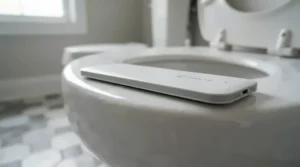
Brondell is one of the better-known names in bidets, and the Thinline line is built around this exact problem. Roundups describe the body as roughly a quarter inch thick, with dual nozzles, a side-arm control, and tool-free installation.
The side-arm dial is more than a styling choice. It sits at the seat’s edge, so you can adjust pressure without twisting around. A single-nozzle sibling, the Brondell SimpleSpa Thinline SS-150, also exists, so check which version you’re buying.
The honest analysis here involves a caveat. One buyer of the single-nozzle Brondell SimpleSpa Thinline SS-150 reported that their seat still sat at an odd angle. The culprit wasn’t thickness but the unit’s front-to-back width, which interfered with that particular seat’s shape. That’s a useful reminder that a thin number doesn’t guarantee a flat seat. A separate roundup praises the SS-250 for avoiding the flimsy-plastic and leaky-connection complaints common in the entry tier, though that’s one reviewer’s view.
Pros:
- ✅ Thin body with easy side-arm pressure dial
- ✅ Established brand with accessible support
- ✅ Tool-free installation
Cons:
- ❌ Some seats still tilt due to unit width
- ❌ Costs more than generic ultra-slim rivals
Plan on roughly the $30-$50 range. It’s a solid value if you want a recognizable brand without a premium price.
3. TUSHY Classic 3.0 — most design-forward pick for renters
The TUSHY Classic 3.0 has become the poster child of the stylish bidet attachment, and for good reason. Its listing describes a three-step DIY install: unscrew the seat, pop the unit on, and connect water and seat. It also features a SmartSpray nozzle with precision angle control and adjustable pressure.
What does that mean for a small bathroom? The angle control lets you aim without contorting yourself, which matters when the bowl is narrow. Owners quoted in one roundup praise the slim profile for fitting beneath most standard seats without a noticeable gap. Bob Vila’s review gave it a 4.5/5 rating, which lines up with the generally positive sentiment.
The trade-off is that this is a single-nozzle design. If you need a feminine wash, consider a dual-nozzle alternative. It also costs noticeably more than the generics, and you’re partly paying for the look and brand.
Pros:
- ✅ Quick, tool-light installation
- ✅ Precise angle control for narrow bowls
- ✅ Minimalist look suits modern bathrooms
Cons:
- ❌ Single nozzle, so no dedicated feminine wash
- ❌ Priced well above no-name slim units
Expect roughly the $70-$100 range. It’s worth it if aesthetics and spray control are priorities, and overkill if they aren’t.
4. LUXE Bidet NEO 120 — the volume leader with a famously simple design
Few bidet attachments have the sales footprint of the LUXE Bidet NEO 120. One retailer listing showed over ten thousand reviews with a near-5-star average at research time, which is rare statistical weight for this category.
It’s a single-nozzle, self-cleaning design with a metal-ceramic valve core and a nozzle guard. The manufacturer argues that thinner isn’t always better, because seat interference usually comes from the nozzle housing extending into the bowl rather than plate thickness. That’s a fair engineering point, and it’s why you should weigh real-world fit reports over raw millimeters.
LUXE also publishes a seat-support page covering edge cases: a gap exceeding one inch, or a seat’s inner lip resting on top of the unit. Its answer to a big gap is tall hinge covers. Honest takeaway: it’s the safe default for first-timers, but not the pick if you need a feminine wash (consider the dual-nozzle LUXE Bidet NEO 185 instead).
Pros:
- ✅ Enormous review base and long track record
- ✅ Self-cleaning nozzle with protective guard
- ✅ Metal-ceramic valve core aids durability
Cons:
- ❌ Single nozzle, no feminine wash
- ❌ Seat lip can contact the unit on some toilets
Look for roughly the $40-$60 range. It’s excellent value for reliability.
5. Bio Bidet SlimEdge — brass plumbing in a thin, removable package
Roundups position the Bio Bidet SlimEdge as a compact-profile attachment that sits close to the bowl, with brass plumbing and dual nozzles. The brass detail matters because fittings, not plastic plates, are where cheap bidets typically fail.
It’s also described as removable, which suits renters or anyone who occasionally swaps seats. One roundup flags a caveat shared by many slim designs: a slim profile can block a small portion of the bowl, so the seat may need a small repositioning to sit level on some toilets.
Reviewer volume for this model is harder to verify than for the category leaders, so treat the enthusiasm in roundups as promising rather than proven. If you value brass internals over rock-bottom price, it’s a smart middle path.
Pros:
- ✅ Brass plumbing improves leak resistance
- ✅ Dual nozzles in a compact body
- ✅ Removable for seat swaps
Cons:
- ❌ Can crowd the bowl on some toilets
- ❌ Fewer verifiable reviews than market leaders
Prices commonly land in roughly the $40-$70 range, so confirm on the listing. It’s good value if brass matters to you.
6. Veken Ultra-Slim — budget dual-nozzle with self-cleaning nozzles
The Veken Ultra-Slim targets the “just give me both nozzles cheaply” crowd. It offers a dual-nozzle setup for rear and feminine wash, self-cleaning behavior, and adjustable pressure, and roundups say it installs without extra tools.
What matters in a small bathroom is that its slim housing is designed to slide under most seats without adding bulk. Aggregated reviewer notes are mostly positive about installation ease and sleek looks. One published review nonetheless lists a potential for leaks over time as its main con.
That’s a pattern with budget units: the connection points, such as the T-adapter and hose gasket, deserve a careful hand-tightening and a periodic check. Keep a spare rubber washer on hand and you neutralize most of the risk.
Pros:
- ✅ Dual nozzles at a budget price
- ✅ Simple, tool-free installation
- ✅ Self-cleaning nozzle design
Cons:
- ❌ Some reports of leaks developing over time
- ❌ Plastic-heavy build versus brass options
Expect roughly the $20-$35 range. It’s a good value if you inspect the fittings now and then.
7. BIGCOW Ultra-Slim — lowest-cost entry with a stainless steel inlet
At the budget end, the BIGCOW Ultra-Slim keeps the formula simple: dual nozzles (frontal and rear wash), adjustable cold-water pressure, and a stainless steel inlet. Roundups consistently say it fits most toilets and installs easily.
Its stainless steel inlet is the notable detail for the price, since it’s a connection component rather than a cosmetic one. For a guest bathroom, rental, or first experiment with bidets, that’s a low-stakes way in. Deal-tracker pages have shown it discounted into the low-to-mid $20s at points, but prices move, so don’t treat any snapshot as a promise.
The honest limitation is warranty and long-term support, which are generally less established than with name brands. If it fits your seat, it delivers the core experience for pocket change. If not, you’ve lost very little.
Pros:
- ✅ Dual nozzles at the lowest cost
- ✅ Stainless steel inlet for the connection
- ✅ Adjustable pressure knob
Cons:
- ❌ Cold-water only
- ❌ Less brand support than established names
Expect roughly the $20s-$30s range. It’s strong value for low-risk experimenting.
✨ Ready to upgrade your tiny bathroom?
🚽 Click any highlighted product name above to check current pricing and availability. Each of these picks is chosen to slide under a seat without stealing precious space, so you can enjoy a cleaner routine your whole household will notice!
How to Choose a Slim Profile Bidet Attachment for Small Toilets
Choosing well takes about five minutes of measuring, and it prevents the number-one regret: a seat that won’t sit flat. Work through these steps in order.
- Measure your seat’s hinge-to-tank clearance. Tight spacing means every fraction of an inch counts, so favor the thinnest plates (the SAMODRA Ultra-Slim or Brondell SimpleSpa Thinline SS-250).
- Check your seat’s underside. Look at the rear bumper height and the inner lip. If bumpers are tall, a bidet adds less visible gap, and if they’re flat, expect to add spacers.
- Decide on nozzles. Rear-only (LUXE Bidet NEO 120, TUSHY Classic 3.0) is fine for many people, but a dual nozzle suits households wanting a feminine wash.
- Weigh valve materials. Brass or metal-ceramic cores (like the Bio Bidet SlimEdge or LUXE Bidet NEO 120) generally mean fewer headaches than all-plastic fittings.
- Check the water connection. Confirm your supply line size matches the included T-adapter, and keep an eye out for rubber washers in the kit.
- Plan for cold water. Every unit here is cold-water. If that bothers you, budget for a warm-water model instead.
- Read recent reviews for your seat type. Round, elongated, and soft-close seats behave differently, so search review text for your exact seat style.
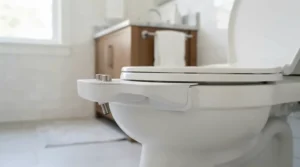
Seat Gap Clearance: The Measurement That Decides Everything
Seat gap clearance is the vertical space between the underside of your toilet seat and the porcelain rim once the bidet is installed. It’s the single most misunderstood factor in this whole category.
Here’s the physics. A standard seat rests on four points: two hinges at the back and two bumpers near the front. Slide an attachment under the hinges and you lift the rear. One how-to guide on spacers estimates that bidet attachments typically add roughly 0.4 to 1.5 inches of material, which creates an uneven load and can wobble or stress the plastic.
So thinness helps, but it isn’t the whole story. As the Brondell SimpleSpa Thinline SS-150 buyer example showed, a unit’s front-to-back footprint can tilt a seat even when it’s thin. And Brondell’s own fit-measurement guide for its seat products stresses having at least roughly 1½ inches between your bolt holes and the tank, a good reminder to measure before buying anything.
| Factor | What It Affects | Quick Fix | Best For |
|---|---|---|---|
| Plate thickness | Overall seat lift | Choose thinner units | Tight hinge-to-tank spaces |
| Front-to-back width | Seat angle | Check seat shape in reviews | Oddly shaped bowls |
| Bumper height | Front-edge gap | Taller bumpers or spacers | Seats that rock |
| Hinge covers | Large gaps over 1 inch | Tall hinge covers | Thicker attachments |
Reading the table, plate thickness is the headline, but the other rows are why two “slim” units can behave very differently. If your seat rocks after install, adhesive bumpers or spacers typically solve it in minutes, so don’t panic. For the TUSHY Classic 3.0 and LUXE Bidet NEO 120, small bumper tweaks are a common remedy.
Low Profile Bidet Attachment for Narrow Toilet Seats: Reading the Fine Print
Narrow seats, common on compact round-front bowls, create a different problem. There’s less room between the seat’s inner edge and the nozzle housing, so a poorly shaped attachment can sit proud into the bowl opening or press against the seat’s inner lip.
A low profile bidet attachment for narrow toilet seats needs three things. First, a compact housing that doesn’t protrude far into the bowl. Second, a nozzle that retracts cleanly. Third, a shape that allows the seat to close fully without fouling the unit.
The LUXE Bidet NEO 120 and the TUSHY Classic 3.0 are frequently recommended for small spaces, partly because their housings are designed to sit tight. A roundup also notes the Bio Bidet SlimEdge hugs the bowl, though slim designs can block part of the bowl and force minor seat repositioning.
Spec sheets won’t tell you whether the plate collides with your particular seat’s inner lip, but reviewer comments often will. Search reviews for your seat style (round, elongated, soft-close) before buying. When in doubt, consider the SAMODRA Ultra-Slim, whose very thin plate leaves the most margin for error.
Universal Toilet Fit: Is There Really Such a Thing?
Almost every listing promises universal toilet fit, and it’s mostly true, with caveats worth knowing. Most two-piece toilets with standard two-bolt seats accept these attachments, because the mounting hardware sits where seat hinges go.
The catch lies in the details. Bolt-hole spacing varies a little among seat designs, and one-piece or unusually shaped toilets can have trouble. Some retailers state their products fit standard two-piece toilets and most one-piece models, which is a reasonable reading: broad compatibility, but not a guarantee.
Also check your water connection. Attachments tap in through a T-adapter at the supply line, so confirm that the included adapter matches your tank’s connection, and measure bolt-hole-to-tank clearance. Consider these quick compatibility checks:
- ✅ Standard two-bolt seat mounting
- ✅ Accessible supply line near the tank
- ✅ Enough room behind the bolt holes for the unit
- ❌ Unusual wall-mounted or integrated-seat toilets, which often won’t work
No attachment is truly universal, but the slim ones come closest, because they ask the least of your toilet’s geometry.
Ultra Thin Bidet Attachment for Compact Bathrooms: What Actually Changes
An ultra thin bidet attachment for compact bathrooms delivers one underrated benefit: it adds function without adding clutter. No new fixture, no electrical outlet, no floor footprint. You’re upgrading what the toilet already does.
Compare the alternatives. A standalone bidet needs its own floor space and plumbing, which a typical powder room simply can’t spare. A heated bidet seat needs an outlet within reach, which many tiny bathrooms lack. An ultra-thin attachment needs neither, which is why it dominates small-space recommendations.
What do you give up? Warm water, a heated seat, and air drying, so you’ll still pat dry with a little paper or a towel. For most small-bathroom owners, that’s a trade worth making.
Placement also matters. The control lever sits at the seat’s edge, so check you can reach it without hitting a wall or vanity. Slim attachments with side-arm controls (such as the Brondell SimpleSpa Thinline SS-250) are easy to reach, while rotary knobs on some models sit lower on the side. Picture your elbows in the space before committing.
Space Saving Design: Features That Actually Matter (And Those That Don’t)
Marketing loves buzzwords, so let’s sort signal from noise when judging space saving design.
What matters:
- ✅ A shallow plate, which minimizes seat lift
- ✅ A compact nozzle housing that doesn’t crowd the bowl
- ✅ A short, flexible hose that doesn’t snake across the floor
- ✅ A control within easy reach of the seat edge
What matters less:
- ❌ A bamboo handle or pretty finish (nice, but cosmetic)
- ❌ Extra nozzle modes if you’ll only use one
- ❌ Marginal differences in thickness, like 0.19 inches versus a quarter inch, if your seat clearance is already comfortable
The honest nuance is that thinness helps until fit becomes about shape rather than thickness. That’s the argument LUXE makes, and it’s partly right. A unit that’s slightly thicker but narrower front-to-back may seat better than a thinner unit with a broad footprint. Use thickness as a filter, then let fit reports break the tie.

Slim Bidet Attachments vs. Bidet Seats and Toilet Paper
How do slim attachments stack up against the alternatives? The environmental case is worth knowing. Scientific American’s coverage notes that Americans use roughly 36.5 billion rolls of toilet paper a year, representing about 15 million trees, and that making one roll takes around 37 gallons of water. Bidets rinse with a small fraction of that.
| Option | Space & Seat Impact | Typical Cost | Needs Power | Best For |
|---|---|---|---|---|
| Slim attachment | Minimal, under the seat | Roughly $20-$100 | No | Small bathrooms, renters |
| Bidet seat | Replaces seat, bulkier | Higher, often several hundred | Yes | Warm water and dryer fans |
| Handheld sprayer | Adds a hose and holder | Often under $100 | No | Cleaning and flexibility |
| Toilet paper only | None | Ongoing cost | No | No upfront spending |
The table tells a simple story: slim attachments win on footprint and simplicity, while bidet seats win on luxury features. If your bathroom is small, the powered seat often costs more in space and outlets than it delivers in comfort. A slim attachment captures most of the hygiene benefit at a fraction of the price and complexity.
Practical Guide: Installing Your Slim Bidet Attachment (and the First 30 Days)
Installation is genuinely approachable, but a few habits make the difference between smooth and soggy.
- Turn off the water at the shutoff valve and flush to empty the tank.
- Remove the seat by loosening the bolts, then clean around the mounting area.
- Seat the attachment under the seat’s mounting holes, then re-attach the seat.
- Install the T-adapter between the tank and supply line. Hand-tighten, wrap threads with the included Teflon tape if provided, and add the rubber gasket.
- Connect the hose, restore water slowly, and check each joint for drips.
For the first 30 days, watch for drips at the T-adapter, check that the seat doesn’t wobble, and start at the lowest pressure. Many people crank the pressure too high on day one, and a gentle start avoids an unpleasant surprise.
For a quick maintenance schedule, wipe the nozzle weekly, glance at connections monthly, and replace worn gaskets when needed. Retractable nozzles with self-cleaning rinse cycles, as on the LUXE Bidet NEO 120 and Veken Ultra-Slim, reduce the cleaning burden. These small habits keep leaks and grime away for years.
Problem → Solution Guide: Fixing Common Slim Bidet Headaches
Even the best attachments can present quirks. Here are the usual suspects and how to fix them.
Problem: the seat wobbles or sits tilted.
This is the classic seat-gap issue. Add adhesive bumpers or a spacer kit to raise the front. For larger gaps, tall hinge covers (as LUXE offers) can help. If your seat is bargain-bin thin, upgrading to a sturdier seat with more clearance often fixes it permanently.
Problem: a leak at the T-adapter.
Most leaks trace back to a missing or misaligned rubber washer, which is a recurring theme in budget-unit reviews. Reseat the gasket, add Teflon tape to threads, and hand-tighten without over-cranking. Replace a cracked washer.
Problem: weak water pressure.
Open the shutoff valve fully and check that hose kinks aren’t restricting flow. Clean the nozzle screen if debris built up.
Problem: the seat’s inner lip touches the unit and bends the spray.
Tweak the unit’s position slightly or use a seat with a wider opening. A spacer on the opposite side can sometimes shift the angle.
Problem: the water feels shockingly cold.
That’s a cold-water-only reality. Run it briefly first, or consider a warm-water model if your bathroom is chilly.
Each of these takes minutes, not hours, and most are cheap to fix.
Real-World Scenarios: Which Slim Bidet Matches Your Life
Let’s match typical buyers to products using budget, environment, and use frequency.
The apartment renter on a tight budget. Picture a renter with a narrow powder room who wants something removable and inexpensive. The SAMODRA Ultra-Slim or BIGCOW Ultra-Slim fits that brief, with dual nozzles and a minimal footprint, and neither requires a lease-violating modification.
The design-minded homeowner. Imagine a modern-bath owner who cares how fixtures look and wants controlled, comfortable spray. The TUSHY Classic 3.0 matches, thanks to angle control and a clean look, even at a higher cost.
The household of several people. For a family wanting both rear and feminine wash with reliable fittings, the Bio Bidet SlimEdge or Brondell SimpleSpa Thinline SS-250 offers dual nozzles with better build credentials than bargain units.
A word on health: WebMD’s overview notes bidets can be more hygienic than wiping alone, but cautions that research on vaginal health is unclear. If you have specific medical concerns, a doctor can weigh in better than any buying guide.
Long-Term Cost & Maintenance: Does a Slim Bidet Pay Off?
Slim attachments are cheap up front, but the real question is total cost of ownership. One plumbing company estimates households spend roughly $100 to $200 a year on toilet paper. Another source notes that basic attachments in the $60-$100 range can cost less than a year of paper. Even at the lower end of savings, many buyers recoup the cost of a budget unit within months.
Maintenance costs are minimal. Expect to replace a gasket occasionally, wipe the nozzle regularly, and maybe swap bumpers. Budget units like the Veken Ultra-Slim and BIGCOW Ultra-Slim may need more frequent connection checks, while brass-core options like the Bio Bidet SlimEdge or metal-ceramic designs like the LUXE Bidet NEO 120 tend to inspire more confidence for the long haul.
Cost per use falls fast. If a $30 unit serves a household for several years of daily use, you’re paying pennies per day, and you’re probably buying less paper too. Water use is modest, with one source estimating about an eighth of a gallon per use. The spreadsheet verdict: slim attachments are one of the highest-return bathroom upgrades going.
Frequently Asked Questions
❓ Will a slim profile bidet attachment for small toilets fit both round and elongated seats?
❓ Do ultra-slim bidet attachments leak more often than thicker ones?
❓ Can a low profile bidet attachment work with a soft-close seat?
❓ How much should a slim bidet attachment cost?
❓ Does a space saving design bidet attachment need electricity?
Conclusion
Choosing the best slim profile bidet attachment for small toilets comes down to fit first, features second. For the tightest clearance, the SAMODRA Ultra-Slim leads on published thinness. For a recognizable brand with dual nozzles, the Brondell SimpleSpa Thinline SS-250 is a safe bet. For reliability backed by a huge review base, the LUXE Bidet NEO 120 is hard to beat, while the TUSHY Classic 3.0 earns its premium for design and spray control. Budget hunters will find the Veken Ultra-Slim and BIGCOW Ultra-Slim serviceable, and the Bio Bidet SlimEdge brings brass plumbing into a thin package.
Whichever you choose, measure your seat gap clearance, check your water connection, and keep a few adhesive bumpers handy. Most fit problems are cheap, quick fixes, and the payoff is a cleaner, greener bathroom routine without sacrificing an inch of floor space.
Recommended for You
- [Add your blog post link 1]
- [Add your blog post link 2]
- [Add your blog post link 3]
Disclaimer: This article contains affiliate links. As an Amazon Associate, I earn from qualifying purchases. If you purchase products through these links, we may earn a small commission at no additional cost to you.
✨ Found this helpful? Share it with your friends! 💬🤗
